

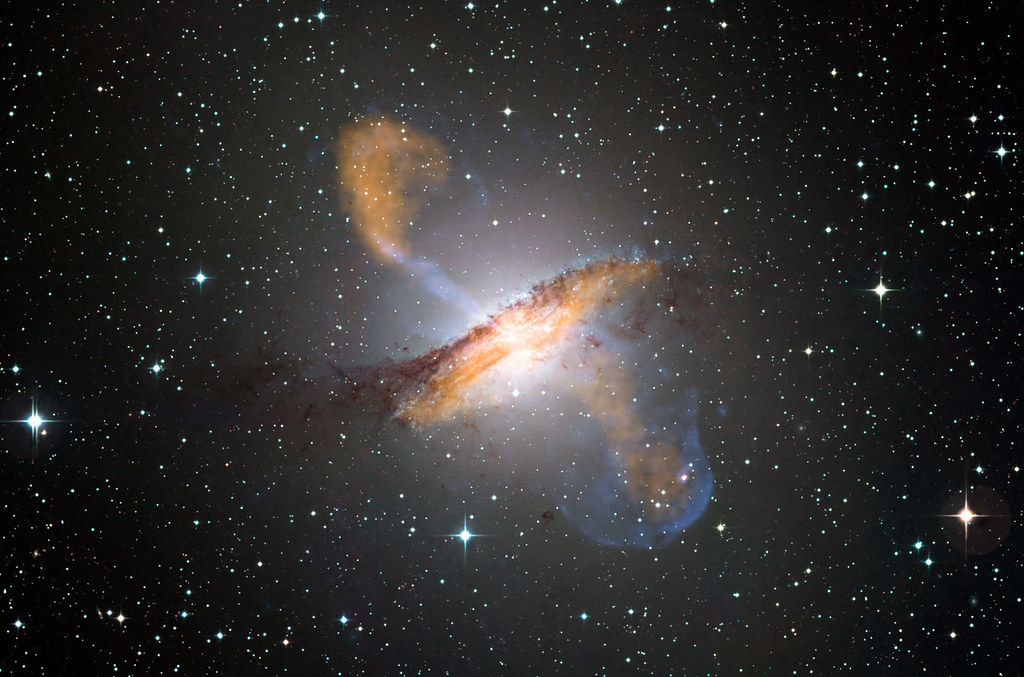
black hole jets are powerful streams of particles that can influence the fate of entire galaxies. Recent studies reveal their critical role in galactic evolution and structure.
What are black hole jets?
Black hole jets are narrow streams of charged particles that are ejected at nearly the speed of light from the regions surrounding supermassive black holes. These jets are a result of the intense gravitational forces and magnetic fields present in the vicinity of a black hole, particularly in an accretion disk where matter spirals inwards. As matter falls towards the black hole, it gets heated to extreme temperatures, causing it to emit vast amounts of energy.
There are two primary types of black hole jets: relativistic jets and non-relativistic jets. Relativistic jets are the faster of the two, often reaching velocities close to the speed of light, while non-relativistic jets travel at significantly lower speeds. These jets can extend thousands of light-years into space, influencing their surrounding environments in profound ways.
The impact of black hole jets on galaxies can be significant. They can regulate star formation by heating and expelling gas, thereby altering the dynamics of galaxy evolution. Some research suggests that black hole jets may even play a crucial role in determining the fate of entire galaxies, affecting their growth and structure over cosmic time. Understanding these jets is essential for comprehending the complex relationships between black holes and the galaxies that host them.
The science behind black hole jets
Black hole jets are fascinating astrophysical phenomena that occur when matter is accelerated to nearly the speed of light and ejected from the regions surrounding supermassive black holes. These jets are primarily formed from the immense gravitational pull of black holes, which draws in surrounding gas and dust. This process ignites a series of complex interactions, resulting in powerful jets that can extend thousands of light-years into space.
The composition of black hole jets is primarily plasma, a state of matter consisting of charged particles. As the material spirals into the black hole, it heats up and emits radiation across the electromagnetic spectrum, from radio waves to X-rays. This radiation can have significant effects on the surrounding environment of galaxies.
- Star Formation: The energy from black hole jets can trigger new star formation in nearby regions but can also suppress it by heating the surrounding gas.
- Galactic Evolution: Black hole jets play a crucial role in regulating the growth and evolution of galaxies by redistributing matter and energy.
- Feedback Mechanisms: The jets can create large-scale feedback loops that affect the temperature and density of intergalactic gas.
Understanding the science behind black hole jets is essential for deciphering their impact on galaxies and the universe at large.
How do black hole jets affect galaxies?
The impact of black hole jets on galaxies is profound and multi-faceted. These energetic jets, propelled at nearly the speed of light, can significantly influence their surrounding environments in several ways.
Firstly, black hole jets are known to regulate star formation within galaxies. The immense energy and matter expelled from the jets can heat up surrounding gas, preventing it from cooling and collapsing into stars. This heating effect can lead to a suppression of star formation, altering the evolutionary trajectory of the galaxy.
Secondly, the interaction between black hole jets and interstellar medium can lead to the creation of large-scale structures. When jets collide with the surrounding gas, they can create shock waves that compress matter, potentially triggering star formation in certain regions while inhibiting it in others.
Additionally, black hole jets can help maintain the balance of a galaxy’s energy output. By expelling energy back into the intergalactic space, these jets can regulate the overall temperature and dynamics of the galaxy. This process plays a crucial role in the lifecycle of galaxies, influencing their growth and stability over billions of years.
In summary, black hole jets are not merely cosmic phenomena; they actively shape the environment of galaxies, determining their fate and evolution in the universe.
Recent discoveries in astrophysics
Recent discoveries in astrophysics have shed light on the complex dynamics of black hole jets and their profound effects on galaxies. Researchers have observed that these jets, which are powerful streams of charged particles ejected from the regions surrounding supermassive black holes, can influence star formation and the distribution of gas in their host galaxies.
One significant finding reveals that the energy emitted by black hole jets can heat surrounding gas, preventing it from cooling and condensing into new stars. This phenomenon can lead to a decrease in star formation rates, ultimately shaping the evolutionary path of a galaxy. Studies indicate that galaxies with active black holes often exhibit a different star formation history compared to those without.
Additionally, recent simulations have shown that the orientation and strength of black hole jets can vary widely, affecting the extent of their impact on the galaxy. Some jets may collide with surrounding gas clouds, creating shock waves that can trigger bursts of star formation in specific regions, while others may disperse matter over vast distances.
As scientists continue to refine their models and gather observational data, the role of black hole jets in the cosmic landscape becomes increasingly clear, suggesting that they are crucial players in determining the fate of entire galaxies.
The role of black hole jets in cosmic evolution
Black hole jets play a crucial role in the cosmic evolution of galaxies, significantly influencing their formation and development. These powerful outflows, generated by supermassive black holes at the centers of galaxies, can have profound effects on their surroundings.
Firstly, black hole jets can regulate star formation within galaxies. When jets collide with surrounding gas and dust, they can heat these materials, preventing them from collapsing into new stars. This process can lead to a decrease in star formation rates, shaping the overall structure of the galaxy.
Moreover, the energy and momentum carried by black hole jets can drive large-scale galactic winds. These winds can expel gas from the galaxy, removing the raw materials necessary for star formation and altering the galaxy’s evolutionary path. Additionally, the interaction between jets and the intergalactic medium can affect the distribution of matter on larger cosmological scales.
Recent studies suggest that the impact of black hole jets may extend beyond their host galaxies. They can influence the growth and behavior of neighboring galaxies, contributing to the dynamic interplay between cosmic structures. In summary, understanding the role of black hole jets in cosmic evolution is vital, as they are not merely byproducts of black hole activity but are key players in the shaping of the universe.
Future research on black holes and galaxies
As researchers continue to delve into the mysteries of the universe, future studies on black hole jets are poised to unveil even more about their profound impact on galaxies. Understanding these phenomena is crucial, as they may play a pivotal role in determining the fate of not just individual galaxies, but also the large-scale structure of the cosmos.
Future research priorities include:
- Observational Studies: Utilizing advanced telescopes will allow scientists to gather more precise data on the properties and behaviors of black hole jets across different environments.
- Simulations: Developing sophisticated computer models will help in predicting the effects of black hole jets on galactic formation and evolution, providing insights into their role in cosmic structure.
- Multi-wavelength Astronomy: Investigating black hole jets through various wavelengths, from radio to gamma rays, will offer a comprehensive understanding of their mechanics and interactions with surrounding matter.
- Interdisciplinary Approaches: Collaborations between astrophysicists, cosmologists, and theoretical physicists will enhance our understanding of the complex dynamics involved in black hole jets and their influence on galaxies.
With these focused efforts, the scientific community hopes to shed light on how black hole jets shape not only the galaxies in which they reside but also the broader universe itself.
By NASA Goddard Photo and Video via Openverse